“By Friday, you’re clearing out of the dacha. Ira’s relatives are moving in for the whole summer,” Pavel said, setting my toolbox down on the porch. “I already took thirty thousand from Nina Zakharovna for food and utilities, so don’t embarrass me in front of people.”
I stood by the door of the garden house and at first thought I had misheard him. Not because Pavel rarely spoke arrogantly. He spoke arrogantly often. But until that evening, he had at least pretended to remember that the dacha in the Beryozka garden association belonged to me, not to his sister Irina, not to his mother Tamara Vasilyevna, and not to some distant relatives who wanted to spend the summer under the apple trees.
“You took money for my dacha?” I asked.
Pavel grimaced, as if I had picked on some trivial detail.
“Not for the dacha. Just in a normal, human way. People will be living here, using electricity, pumping water, buying food. Besides, you sit here alone all summer. Six hundred square meters is too much for you, and they need fresh air for the children.”
“What children?”
“Don’t nitpick. Artyom is already grown, but he needs a quiet place to work. Oleg will come on weekends. Nina Zakharovna and Boris Yegorovich will stay here permanently. Ira has organized everything.”
He spoke with such confidence, as if he hadn’t just promised my house to other people, but had already issued them vouchers to a sanatorium. My gloves, pruning shears, my father’s old jacket, and a packet of seeds were lying on the bench. Pavel had swept them all into one pile to make room for strangers’ bags, and he did not even notice how my face changed.
The dacha had come to me from my father as an inheritance. Six hundred square meters, a house of forty-two point six square meters, a shed, a greenhouse, two apple trees, and a bench near the lilac bush. After the paperwork was completed, I paid the garden association fees myself, fixed the roof myself, bought the boards for the porch myself, and argued with the repairman myself whenever the pump started coughing again after winter.
Pavel merely rested here. Sometimes he grilled meat and called himself the owner because once he had helped paint part of the fence. In his mind, that was enough to give him the right to dispose of the property.
“They are not going to live here,” I said.
“They will, Lena. Don’t start that talk about documents. We’re husband and wife. In a normal family, people don’t divide things like that.”
“In a normal family, people ask first.”
“If anyone asks you, you refuse everyone. You have one answer to everything: mine, mine, mine. Ira is right. You can’t be dealt with nicely.”
Irina’s name was not mentioned by accident. Pavel’s sister had long looked at my dacha as a convenient free base. In spring, she had already hinted that “older people would benefit from living close to the land,” and that I “had to commute to work anyway.” Back then, I had laughed it off. My mistake was laughing at all.
“Who decided that the house would be available starting June twelfth?” I asked.
“We decided,” Pavel replied. “Me, Ira, and Mom. You keep pretending you’re separate. But you’re a wife. That means you have a family too.”
That was his favorite logic. When Pavel needed to take a bag of things to my mother in the hospital, he was busy. When the roof at the dacha needed repairs, he said it was “your inherited little joy.” But the moment his relatives wanted a summer without paying rent, the dacha suddenly became family property.
“Leave, Pavel,” I said. “This conversation is over.”
He smirked and pulled a set of keys from his pocket.
“Where would I go? Tomorrow I’m bringing Irina here so she can see where it’s best to put the mattresses. In the meantime, clear out the big wardrobe, the fridge, and the attic. Nina Zakharovna is not going to live among your junk.”
I picked up the toolbox and carried it back into the house. Pavel was waiting for shouting, insults, a slammed door. He needed a scandal so he could later tell everyone how his wife had ruined a vacation for good people. I closed the door calmly, and he remained on the porch, holding his borrowed confidence in his hands.
That evening, Tamara Vasilyevna called. My mother-in-law did not even say hello.
“Lena, Pavlik is beside himself. Irina is crying. What have you done?”
“I refused to give my dacha to strangers.”
“They are not strangers. They are relatives. Nina Zakharovna is practically family. Boris Yegorovich is a decent man. Artyom works remotely; he needs quiet. You won’t become poor from being alone there.”
“Tamara Vasilyevna, Pavel took money from them.”
“And rightly so. For electricity, water, food. He is the provider, the man of the house. He knows better. You are not a freeloader with him, of course, but you shouldn’t command every single nail either.”
She said it softly, almost affectionately. That was how she always applied pressure: as if she were not humiliating me, but teaching me family wisdom.
“Tell Pavel that he won’t need the keys anymore,” I said.
“You’re going to talk yourself into trouble, Lena.”
“I’ve already come to an agreement with myself. That is enough.”
I hung up and took a folder of documents from the bottom drawer. Inside were the certificate of inheritance dated August 15, 2019, the extract from the Unified State Register of Real Estate dated August 27, 2019, the garden association fee receipts, the roof repair contract, and receipts for the pump and fence materials. I laid the papers out on the table and, for the first time that evening, felt not hurt, but a focused, working anger.
Pavel was not in the documents. He could call himself a husband, a provider, and the king of the barbecue as much as he wanted, but his surname did not appear in the real estate register extract. The next day, I went to see Yulia Petrovna Safonova, a lawyer who helped our garden association with land issues. She did not try to comfort me or give long speeches about family relationships. She simply read the documents, looked up, and asked:
“Does your husband have the old keys?”
“Yes. To the gate, the house, and the shed.”
“Then consider access lost not because of the keys, but because of your carelessness. Fix it. Write a statement to the chairperson, give security a list of authorized people, install new lock cylinders, and don’t argue emotionally with relatives. If they arrive with their belongings, let witnesses see everything.”
“He’ll shout that I’m throwing my husband out.”
“You are not throwing your husband out of shared housing. You are refusing to let third parties move into your property. Those are different things.”
That difference saved my sanity. I stopped replaying Pavel’s words in my head and started doing what I should have done after Irina’s very first hints.
Before lunch, I wrote a statement to the chairperson of the Beryozka garden association. I stated that I was the sole owner of the plot and the garden house, and that third parties were prohibited from staying there without my written permission. On the list of approved persons, I included myself, the repairman for the pump, and Grigory Somov, a security employee, on call. Pavel was not on that list.
The locksmith arrived in the evening. He installed new lock cylinders on the gate, the house, and the shed, checked how the door closed, and charged four thousand eight hundred rubles. I received three new keys: I kept one, put the second in a bank safe-deposit box, and gave the third to the garden association chairperson in a sealed envelope for emergencies.
Pavel realized almost immediately that the old keys no longer worked. That same evening, he arrived with Irina. She got out of the car first, wearing oversized sunglasses and a bright manicure, as if she had come not to someone else’s property, but to the office of an incompetent employee.
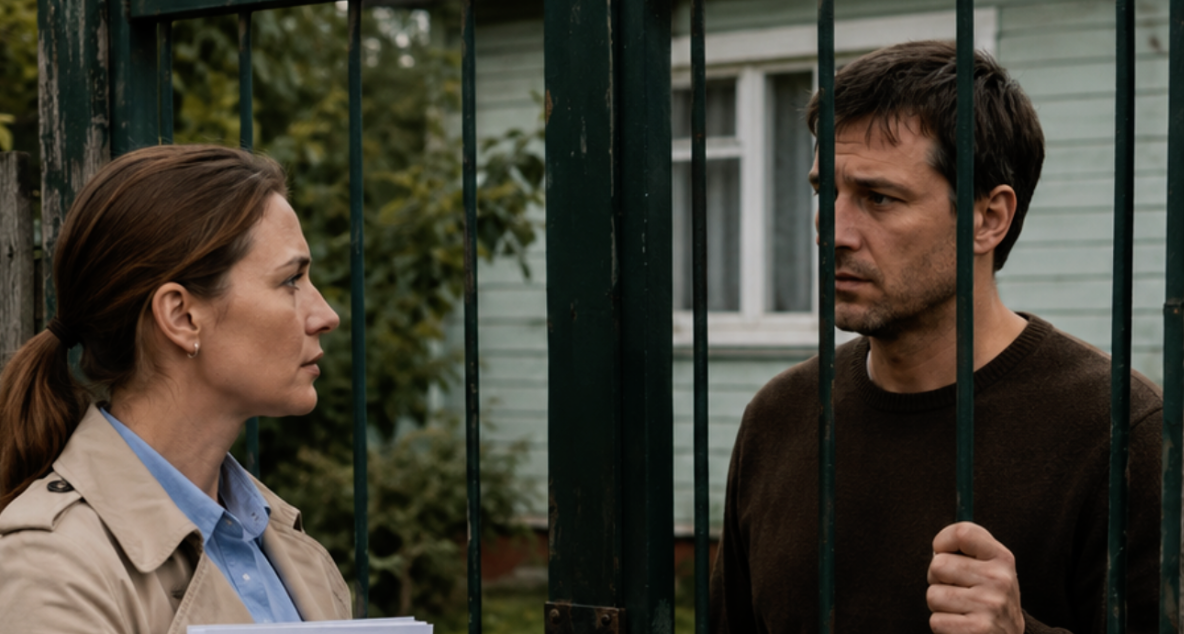
“Lena, are you serious?” she asked, looking at the locked gate. “Pavel couldn’t open it.”
“That means everything works.”
“You locked your husband out of the dacha?”
“I locked my dacha against unauthorized settlement.”
Irina took off her sunglasses and spoke more quietly, but with greater malice.
“We’ve already told everyone. Nina Zakharovna and Boris have packed their things. Artyom rearranged his work. Oleg, my son-in-law, cleared his weekends. Do you understand how you’re setting us up?”
“No, Ira. You set people up when you promised them someone else’s house.”
“Pavel gave permission.”
“Pavel is not the owner.”
Until then, Pavel had been silent, pretending the conversation bored him. Then he stepped toward the gate and pointed at the house behind my back.
“Lena, stop pretending to be a lawyer. You are my wife. We’ve been married for thirteen years. I set up the grill here, painted the fence, carried boards. You’re humiliating me in front of my sister.”
“You brought your sister to a locked gate yourself.”
Irina turned sharply toward him.
“You told me everything was fine with the documents.”
I took a copy of the register extract from my bag and showed it through the gate.
“Everything is fine with the documents. They simply are not in Pavel’s favor. The plot and the house are registered in my name. The basis is inheritance. Neither Pavel, nor Irina, nor Nina Zakharovna is listed here.”
Irina read the page quickly. Her face hardened.
“So what? You’re married. Everything is shared.”
“Not everything. And now you can see that.”
Pavel reached for the paper, but I put it back into the folder. He pressed his lips together and said, not to his sister now, but to me:
“Tomorrow I’m bringing the people here anyway. We’ll see how you put on a show in front of the relatives.”
“Don’t bring them.”
“It’s too late, Lena. They are already coming.”
“Then they will hear the truth not from me, but from you.”
He slammed his palm against the gate, but that was where his strength ended. Irina got into the car silently. It was clear that the family alliance had cracked before they had even managed to place the first suitcase on the property.
On June twelfth, at half past eleven, a minibus stopped at the entrance to the garden association. Irina’s car arrived behind it. I was on the property at the time and had prepared in advance: the document folder was in the house, and my phone was in the pocket of my work vest.
First, two large bags were taken out of the minibus, then folding chairs, a box of grains, two mattresses in covers, and an enormous pot. Nina Zakharovna, wearing a Panama hat, looked over the fence at the plot as if choosing where to plant her flowers. Boris Yegorovich carried an army duffel bag. Artyom held a laptop and clearly wanted to be anywhere except at that gate.
Pavel walked ahead. He deliberately pretended that everything was under control.
“Open it,” he said to me. “People are tired.”
“No.”
“Don’t embarrass yourself in front of everyone.”
“Pavel, you brought everyone to a locked gate yourself. Explain.”
Nina Zakharovna came closer.
“Young woman, Pavel told us the house was ready. We paid money and packed our things. Why aren’t you letting us in?”
“Because I am the owner, and Pavel had no right to take money from you for staying here.”
Those words hit exactly where they needed to. Nina Zakharovna slowly turned to Pavel.
“What do you mean, he had no right?”
Irina interrupted before her brother could answer.
“Lena is just being spiteful. They’re having a family dispute. She’ll open it now.”
“No, Ira,” I said. “Security will arrive now, and you will all hear the same thing without any family embellishments.”
I called Grigory Somov. Pavel smirked, but not as confidently anymore. A few minutes later, a service vehicle stopped by the gate. Grigory got out with another employee, greeted us, and asked for the documents. I handed the copies through the gate. He checked the statement, the surname, and the plot address, then turned to Pavel.
“Entry to the plot is permitted only to persons on the owner’s list. These citizens are not on the list. Please remove your belongings from the gate and do not block the road.”
Pavel straightened up.
“I’m her husband.”
“Do you have a document proving ownership?”
“What does a document have to do with it? I’m her husband!”
“Then resolve family matters separately. Third parties do not enter the property without the owner’s permission.”
Boris Yegorovich set his bag on the ground.
“Pavel, you said the house was jointly yours.”
Nina Zakharovna had already taken out her phone.
“And you didn’t take thirty thousand ‘for food.’ You said it was our share for the summer. I didn’t delete the messages.”
Irina shot a sharp look at her brother. Pavel tried to wave it off.
“Nina, don’t start. I’ll sort everything out now.”
“You already sorted it out,” Nina Zakharovna replied. “Return the money.”
“I’ll transfer it later.”
“Now. In front of everyone.”
For several seconds, Pavel looked at me as if I had forced him to do something humiliating. But he had brought that humiliation himself: in the minibus, with the mattresses, with the pot, with his sister, and with other people’s expectations. He opened his banking app and transferred thirty thousand rubles to Nina Zakharovna. She waited for the notification and only then put her phone away.
“It’s arrived,” she said. “Boris, load everything back.”
Artyom was the first to pick up a mattress. Boris Yegorovich silently took the army bag. Nina Zakharovna carried the pot as if it contained not lunch, but Pavel’s entire reputation. Irina tried to explain something about a “family misunderstanding,” but no one was listening to her anymore.
Pavel stood by the gate without keys, without money, and without the confidence with which he had been handing out my house for the entire summer two days earlier.
When the belongings had been loaded back up, Nina Zakharovna approached him once more.
“You are not offering us anything again. Not a dacha, not help, not any family arrangements. Understood?”
Pavel said nothing. For him, that was worse than shouting.
The minibus drove away. Irina’s car remained by the road, but Irina herself was no longer looking at me. She was speaking to her brother briefly and angrily, and for the first time in the whole conflict, Pavel did not interrupt.
A few minutes later, he came back to the gate.
“Open it. We need to talk normally.”
“We already talked.”
“Lena, I went too far. But you weren’t exactly innocent either. In front of security, in front of the relatives, in front of my sister…”
“You took money for someone else’s house. I’m not the one who disgraced you.”
“I wanted to help Ira.”
“You wanted to look generous at my expense.”
He was silent for a while, then said what he always said when he lost control:
“You won’t manage here without me. The pump, the fence, the car, heavy bags. You’ll still call me.”
“The repairman fixes the pump. I paid for the fence myself. I’ll carry the bags one at a time.”
Pavel looked at the locked gate. Before, he had considered it his door. Now it was a boundary he could not cross with a loud voice, with the word “husband,” or with his mother’s complaints.
“So, divorce over a dacha?” he asked.
“No. Divorce because you decided to evict me from my own house to please your sister.”
He tried to smirk, but it came out badly. Then he turned around and walked toward Irina’s car. She did not open the door right away. Apparently, Pavel had to knock on the window like an ordinary passenger who was not particularly welcome.
On June thirteenth, through Yulia Petrovna, I sent Pavel a written notice: the presence of third parties on the property without my consent was prohibited, the old keys were considered invalid, and any attempts to bring in belongings would be documented. That same day, I filed for divorce.
That evening, Pavel came alone. I did not open the gate. He silently picked up the box I had placed by the entrance in advance: a couple of “guest” mugs, his apron with the words “King of the Grill,” an old grill grate, and the cheap skewers he had been so proud of. There was no conversation. He took the box, put it in the trunk, and drove away.
I returned to the house, locked the door, and put the folder of documents back into the drawer. Then I wrote down ordinary summer tasks in my notebook: fix the pump, paint the porch, pick the currants, order soil for the garden beds. My father’s jacket was still lying on the bench near the lilac bush. I hung it back in its place, next to the work gloves.
The dacha became a dacha again. Not a free base for someone else’s relatives, not a reason for Pavel to pretend to be the owner, not a family storage space for mattresses and pots. Just my house on six hundred square meters of land, where from now on only the people I was willing to let in could enter.