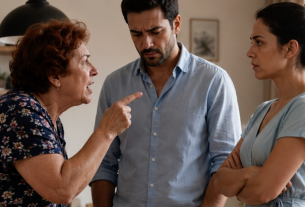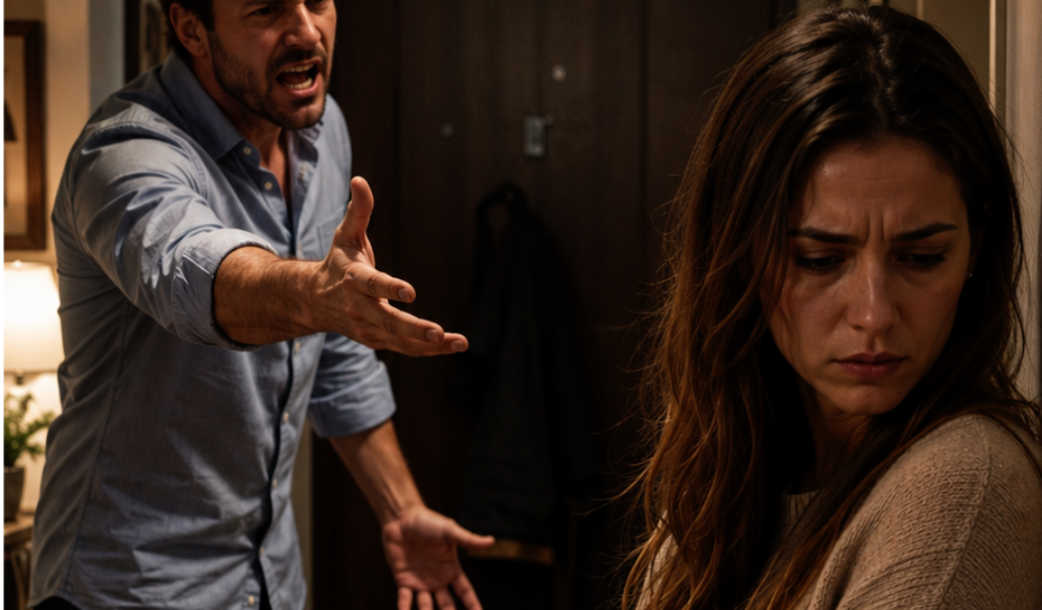
“Have you completely lost your conscience?! You kicked my son out!”
Pavel burst into the apartment so abruptly that the front door slammed against the stopper. Elena did not flinch, and she did not even turn around right away. She was standing in the bedroom by the open wardrobe, packing his things into a suitcase: sweaters with sweaters, T-shirts with T-shirts, house pants separately, socks separately. She did not throw them, crumple them, or toss them around. She did everything evenly, almost casually, as if she were packing her husband for a business trip.
Only there was no business trip.
Pavel walked down the hallway in his jacket and outdoor shoes. Red blotches appeared on his face, his breathing was uneven, and his fingers clenched and unclenched as if he had been preparing his speech all the way up the stairs and was now afraid of losing his anger.
“Do you hear me?” he shouted. “You kicked my son out!”
Elena placed a gray hoodie into the suitcase, zipped the side compartment, and only then turned around.
“I hear you.”
“Then explain what you think you’re doing!”
“I asked Artyom to move out.”
“Asked?” Pavel stepped into the room. “He called me from the street! With his bags!”
“Then he understood the first time. A rare achievement over the past few months.”
Pavel jerked his chin as if he had been slapped.
“He is my son.”
“I remember.”
“He isn’t a stranger!”
“Not to you.”
“And what is he to you? An outsider? An unwanted person? A burden?”
Elena looked at him calmly. Too calmly for someone who had just been yelled at.
“To me, he is a grown man who lived in my apartment for several months without any agreement, didn’t work, didn’t help, was rude, and believed I was supposed to adjust myself to him.”
“When you married me, you knew I had a child!”
“The child has grown up, Pavel. And for some reason, he grew up convinced that his father would always cover for him at someone else’s expense.”
Pavel opened his mouth, but no answer came immediately. His gaze slid to the suitcase on the bed, lingered on the neatly folded clothes, and then returned to Elena. He clearly did not understand. Or he understood, but was not yet willing to admit it.
There were still traces of the recent scandal in the kitchen. A crumpled napkin lay near the table. By the sink stood a plate with the remains of dinner, which Artyom had refused to clean up after himself. An opened pack of cookies lay on the table, crumbs scattered along the edge. In the sink, a mug darkened with dried coffee. Elena had only managed to wash the hallway floor after his dirty sneakers; she had not yet gotten around to the kitchen.
It was because of that kitchen that everything had finally snapped.
Artyom had already been living with them for the fourth month. He arrived at the end of winter with two backpacks and an old travel bag. Pavel had stood in the hallway then, looking guilty, rubbing the back of his neck with his palm and asking:
“Len, things didn’t work out with his housing. Let him stay for a couple of weeks. He’ll find a job, look for a room, and move out.”
Elena did not make a scene. Things happen in life: arguments with roommates, losing a job, a failed rental, debts for a room. Artyom was twenty-six, but she decided not to meet him at the door with suspicion. She agreed. But she said right away:
“Pavel, a couple of weeks means a couple of weeks. A month at most. Not some vague ‘until he gets settled.’”
“Of course,” her husband answered quickly. “I’ll keep everything under control myself.”
For the first few days, Artyom kept quiet. He thanked her for dinner, cleaned up his cup after himself, and almost never left the living room, where they had made up the sofa for him. Elena even thought she had been tense for no reason. The guy was withdrawn, a little sharp, but not rude. In the evenings, he sat on his phone, sometimes came into the kitchen, drank water, and closed the door again.
After two weeks, he no longer asked whether he could take food. After a month, his jacket was constantly hanging over Elena’s coat, his sneakers stood in the middle of the hallway, and his wet towel after a shower ended up either on the washing machine or on the floor. He occupied the bathroom for a long time, washed his clothes, and left them in the drum for days. At night, he watched videos so loudly that the sound came through the wall.
At first Elena spoke calmly:
“Artyom, please put your plate away.”
“In a minute.”
The plate stayed there until morning.
“Artyom, your shoes are blocking the way.”
“I’ll move them.”
The sneakers were simply turned with their toes facing another direction.
“Artyom, don’t turn on the TV after midnight.”
“I’m being quiet.”
“I woke up.”
“Well, sorry for existing.”
After that phrase, Elena looked at him for the first time not as her husband’s temporarily lost son, but as a person who had quickly realized that he would be protected here.
That evening, she waited for Pavel and said:
“We need to talk about Artyom.”
Pavel frowned before the conversation even began.
“Len, just no nitpicking. He’s going through a difficult period.”
“A difficult period does not give him the right to turn someone else’s home into a dormitory.”
“He just isn’t used to it.”
“To what? Cleaning up after himself?”
“You’re overreacting.”
Elena fell silent then. Not because she agreed. She simply saw what every future conversation would be like: she would name specific things, and Pavel would soften them, justify them, and turn it into “don’t nitpick.”
Then Artyom brought two friends into the apartment. Without warning. Elena came home and heard strangers laughing before she even reached the hallway. In the living room, food wrappers, phones, and empty soda bottles lay on the coffee table. One guy was sitting on the floor near the sofa, eating straight from a container Elena had prepared that morning for herself for two workdays.
Artyom did not even get up.
“Oh, Elena. We won’t be long.”
She took the bag off her shoulder and placed it on the cabinet.
“I did not allow you to bring guests.”
“What, am I under supervision?” he smirked. “My father lives here too.”
The room grew quieter. His friends exchanged glances. Elena slowly inhaled so she would not break into a shout.
“Your father lives here as my husband. You are here temporarily because I agreed to help. Do you feel the difference?”
Artyom leaned back against the sofa.
“Very hospitable.”
The guests left twenty minutes later. But that evening, Pavel had a conversation with her.
“You humiliated him in front of his friends.”
“He brought them without asking.”
“They weren’t criminals.”
“Should I expect overnight guests next time?”
“Don’t exaggerate.”
“Pavel, I came home and found strangers in my living room.”
“There it is again — my living room. You keep emphasizing it.”
“Because you’ve stopped taking it into account.”
He fell sharply silent then, but a minute later he started speaking again, softer this time:
“Len, he lost his job. He needs a sense of normality.”
“Normality is when a person understands the rules of the place where he has been taken in.”
“He is my son.”
“And I am your wife. I exist too.”
Pavel looked away. In words, he agreed that Elena was right, but the very next day he said something completely different to Artyom: “Don’t get into it,” “she’s tired,” “be patient,” “I’ll handle it.” Not “apologize.” Not “help.” Not “move out by the deadline you promised.”
From then on, Artyom’s behavior became quieter, but more insolent. He stopped bringing friends over, but he began demonstratively ignoring her requests. Elena told him to put his shoes away — he moved them toward the wall, but in such a way that she still had to step around them. She asked him not to touch the food she took to work — he replied that he had not seen a label. She reminded him about looking for a room — he said that “the market is difficult right now,” although he never got further than scrolling through listings on his phone.
One day she found him at the cabinet with documents. He had taken out a folder with warranties, receipts, and paperwork for appliances.
“What are you doing?”
Artyom turned around without the slightest embarrassment.
“I’m looking for a warranty. My headphones broke.”
Elena took the folder from his hands.
“These are my documents. You cannot touch them without asking.”
“It’s not like I stole your passport.”
“Artyom, you are an adult. I should not have to explain the obvious to you.”
He snorted.
“There are bans everywhere here. Like a museum.”
That evening, Pavel once again took his usual position.
“He didn’t mean any harm.”
“He opened the cabinet and went through the documents.”
“He didn’t understand there was anything important there.”
“Then let him learn to understand.”
“You speak to him like he’s an enemy.”
“I speak to him like a person who has stopped hearing ordinary requests.”
Pavel tiredly ran a hand over his face.
“Len, give him a little more time.”
“How much?”
“I don’t know. Until he gets settled.”
“You said that in February.”
“It was different then.”
“It was different in March too. And in April. Pavel, you and Artyom always find a reason why I should endure a little longer.”
He did not answer. He simply went to his son. Behind the closed door, they spoke quietly, but Elena heard separate words. Pavel was comforting Artyom again, not setting conditions for him.
After that, Elena caught herself for the first time not wanting to come home. She could linger by a shop window even though she had no intention of buying anything. She could walk an extra bus stop on foot. She could stand in the courtyard and look at the windows of her own apartment, gathering her strength before going upstairs.
It was humiliating.
She had not obtained the apartment by lucky chance. Elena had bought it before marriage, when she worked as a production technologist and took extra shifts. The apartment had been old, with a worn-out kitchen, creaking cabinet doors, and a bathroom where the faucet constantly leaked. She had chosen the materials herself, argued with workers, accepted deliveries, and scrubbed the floor after the renovation. Every corner here was not just part of a home, but proof that she had managed to build a peaceful place for herself.
Pavel appeared later. Calm, solid, with a tired smile and the ability to fix everything that others had avoided for years. He did not pressure her, did not rush her, did not immediately ask to live together. Elena valued that more than beautiful words back then.
When they got married, Pavel moved in with her. His former apartment after his first marriage had been sold; he had not lived in a rental for long and said he was tired of everything temporary. Elena immediately stated the most important thing:
“We live at my place. The apartment remains mine. No discussions about shares or re-registration.”
Pavel was even offended then.
“Do I look like a housing hunter?”
“I don’t know. That’s why I’m saying it in advance.”
He thought for a moment, then nodded.
“Fair enough.”
Elena remembered that word. Fair. For a long time, it seemed to her that this was exactly how they lived.
Until Artyom appeared in the apartment.
The last straw came today. Elena was let off work early because the production line had stopped. She bought groceries, went upstairs, and heard Artyom’s voice from the hallway. He was on a video call. The living room door was slightly open.
“I’m settled just fine,” he said with a lazy chuckle. “Dad lives at his wife’s place, the apartment is spacious. She’s a bossy one, true, but it’s nothing. She’ll grumble and get used to it.”
Elena stopped. The handles of the shopping bag cut into her fingers. She placed the groceries on the floor and walked into the room.
Artyom was sitting on the sofa with his legs stretched out on the bedspread. A plate lay on the floor near him. He saw Elena and quickly ended the call.
“What’s the big deal?” he asked first, although she had not said anything yet.
Elena looked at the plate, at the marks from his socks on the bedspread, at the phone in his hand.
“Pack your things.”
He blinked.
“What do you mean?”
“Exactly what I said. You are not spending another night here.”
“Does my father know?”
“No.”
“Then I’m not going anywhere.”
“You are.”
Artyom got up from the sofa. There was no worry on his face, only the outrage of a person who had suddenly been deprived of a comfortable place.
“Who are you to kick me out?”
Elena did not even raise her voice.
“The owner of the apartment.”
“I’m so sick of you and your apartment!”
“And I’m sick of your behavior.”
“I’ll call my father.”
“Call him.”
“He’ll explain things to you.”
“Let him try.”
For several seconds, they looked at each other. Earlier, Elena would have begun proving, explaining, listing things. Today she simply opened the wardrobe in the living room, took out his bag, and placed it on the sofa.
Artyom packed noisily. He slammed cabinet doors, threw clothes, and muttered under his breath. He tried to take a blanket, but Elena stopped him.
“That is not yours.”
“It’s old anyway.”
“Then it will calmly stay here.”
He smiled angrily.
“You’ll regret this.”
“Not this. Definitely not this.”
“Father will put you in your place quickly.”
Elena opened the front door.
“Tell him I’m home.”
Artyom left, slamming the door loudly. Elena turned the lock and stood in the hallway for some time, looking at the dirt marks from his shoes. The silence did not bring relief. Because she knew: now Artyom would call Pavel, tell him everything in the way most convenient for him, and Pavel would come not to figure things out, but to defend him.
She washed the floor. Cleared the plate from the living room. Put Artyom’s forgotten small things into a bag: a cap, a charger, one glove. Then she took out a suitcase.
At first, she packed Pavel’s things slowly. Then her movements became more precise. Clothes into one suitcase. Shoes into a travel bag. Tools into a box. Fishing gear into a separate bag. She did not damage anything, throw anything away, or hide anything. She did not need revenge. She needed order.
On the kitchen table, she placed a folder with documents: the property extract for the apartment, the marriage contract, copies of important papers. Not for show. So that Pavel would not begin his usual “I live here too” as if living somewhere turned someone else’s property into common property.
And now he was standing in the bedroom, boiling with indignation and still not understanding that the suitcase on the bed was no accident.
“Do you even understand that he could be anywhere right now?” Pavel pointed toward the hallway.
“He arranged to stay with a friend. I heard him.”
“You were spying?”
“He was talking loudly.”
“My God, Elena, you threw my son out and now you’re justifying yourself!”
“I’m not justifying myself.”
“Then what are you doing?”
“Finishing what should have been finished earlier.”
Pavel finally looked more closely at the suitcase.
“Are those my things?”
“Yes.”
He froze. The anger on his face wavered, giving way to disbelief.
“You decided to kick me out too?”
“I decided that you are not spending tonight here.”
“Because of Artyom?”
“Because of you.”
“Because of me?” Pavel smirked, but his voice sounded uneven. “Am I guilty because I defended my son?”
“You didn’t defend him. You allowed him to behave as if I were service staff here.”
“Don’t exaggerate.”
“I’m not going to argue with that word anymore. You call everything inconvenient for you to admit an exaggeration.”
Pavel took off his jacket and threw it on the armchair. Elena immediately said:
“You’ll take the jacket too.”
He turned sharply.
“Are you serious right now?”
“Yes.”
“We’ve lived together for so many years!”
“And in those years, you should have understood better where help ends and being used begins.”
Pavel walked to the window, then back. Nervousness appeared in his movements. He was still trying to maintain pressure, but his gaze kept returning to the suitcase, to the open wardrobes, to the empty shelf.
“Artyom will apologize,” he said more quietly. “I’ll talk to him.”
“No need.”
“What do you mean, no need?”
“I no longer need his apologies. They won’t change anything.”
“What will change things, then?”
“Your absence from here tonight.”
He let out a short, angry laugh.
“So that’s how it is. So now I’m unwanted too?”
“Not unwanted. But I don’t want to live with a person who chooses a convenient lie over an unpleasant truth every time.”
“What lie?”
“That Artyom is trying. That he is looking for work. That he is just tired. That I’m nitpicking. That I need to be patient. You repeated this for months, even though you saw everything yourself.”
Pavel fell silent.
Elena walked to the wardrobe, took his shirt from the top shelf, and placed it in the suitcase.
“Do you remember giving him a spare key?”
Pavel frowned.
“When was that?”
“In early March. I asked you to take it back. You said you had.”
He looked away.
Elena nodded to herself.
“So you didn’t.”
“He could come in if we weren’t home. You never know.”
“Exactly. You never know what he might decide to do in an apartment where he does not respect the owner.”
“Don’t call yourself that in front of me.”
“Why? Because it prevents you from treating my home like a shared convenience?”
Pavel clenched his jaw.
“You’ve become harsh.”
“No. I’ve stopped being convenient.”
They went into the kitchen. Pavel saw the folder on the table, opened it, flipped through the documents, but clearly did not read them. The papers rustled under his fingers.
“You prepared in advance?”
“Today. After Artyom left.”
“Fast.”
“On the contrary. Very slow. I simply stopped postponing it today.”
Pavel sank down onto a chair. He no longer looked angry, but lost. Elena saw before her a man who was used to her outrage sooner or later turning into exhaustion, and exhaustion into concession. But now everything was different.
“Len,” he said, trying to speak more softly. “Let’s not go to extremes. I’ll go to Artyom, talk to him. He’ll find a place. I promise.”
“You’ve promised that more than once.”
“This time for sure.”
“This time it’s too late.”
“Because of one conversation?”
“Because of four months. Because of dirty dishes, strangers as guests, noise at night, opened documents, your excuses, and my habit of falling silent after every scandal.”
Pavel ran a hand over his face.
“I was torn between you.”
“No. You stood beside him and asked me to move aside.”
He looked up. The phrase hit exactly where it needed to. Pavel wanted to object, but instead he only looked toward the hallway.
“And where am I supposed to go now?”
“To Artyom. To an acquaintance. To a hotel. Rent a place.”
“So after all these years, you’re just throwing me out?”
“I am taking back my home.”
“Sounds beautiful.”
“At least it’s honest.”
He stood up, walked into the hallway, and only there saw the full scale of it: the suitcase, the bag with shoes, the box with tools, the bag with fishing gear, and a separate bag with Artyom’s small things. His work papers and chargers lay on the cabinet.
Pavel looked at the things for a long time.
“You really decided everything.”
“Yes.”
“And what if I don’t leave?”
Elena stood by the door, straight, not looking away.
“Then I will call the police and say that a person is refusing to leave my apartment after I have demanded it. I don’t want it to come to that, but I can do it.”
Pavel turned pale.
“You’ve put me on the same level as strangers.”
“You did everything yourself to make me stop feeling at home beside you.”
At that moment, his phone rang. Artyom’s name lit up on the screen. Pavel looked at Elena, then answered.
“Yes.”
His son’s voice could be heard even from a distance:
“So? Did you talk to her? Can I come back? It’s uncomfortable at Vitek’s place. His girlfriend is home.”
Pavel closed his eyes.
“Artyom, now is not the time.”
“What do you mean, not the time? Did you tell her she had no right to do that?”
Pavel remained silent. Elena saw how, for the first time that evening, not anger but an unpleasant understanding appeared on his face. Artyom had not asked what had happened to his father. He had not asked where Pavel was. He was demanding his comfort back.
“Dad, do you hear me?” Artyom continued irritably. “Tell her I’ll pick up the rest tomorrow. And tell her not to touch my things.”
Elena took the bag with his forgotten small items and handed it to Pavel. He accepted it automatically.
“You’ll pick them up from me,” he told his son.
“Where are you?”
Pavel looked at the suitcases.
“I’m leaving too.”
The line went quiet.
“She kicked you out too?”
Pavel did not answer right away.
“We’ll talk later.”
“No, tell me now! Is this all because of her? Did she set this up on purpose?”
Pavel ended the call.
Elena felt no triumph. She did not want to finish him off. She simply no longer intended to save Pavel from the consequences of his own decisions.
“He didn’t even ask where you were going,” she said.
“Don’t.”
“I’m not continuing.”
Pavel put his phone into his pocket.
“Give me at least a couple of days.”
“No.”
“Elena.”
“No. A couple of days will turn into persuasion again. Then Artyom will come to ‘pick up his things,’ stay for an hour, then for the evening. You’ll say it’s inconvenient to throw him out immediately. And everything will return.”
“It won’t.”
“I’m no longer testing promises on myself.”
He took the suitcase. Put it down. Then took it again.
“The key,” Elena said.
Pavel frowned.
“What?”
“Return the apartment key.”
“Don’t humiliate me.”
“This is not humiliation. This is access to my home.”
“I’m not a thief.”
“That’s why I’m asking directly.”
He took out his keyring. The ring was tight, and the key did not come off right away. Pavel exhaled in irritation, pried the metal with his fingernail, and finally placed the key in her palm.
Elena closed her fingers around it.
“Does Artyom have a key?”
Pavel looked away.
“I’m not sure.”
“Find out today. If the key is not returned, tomorrow I’ll call a locksmith and change the lock cylinder.”
“You’ve completely…”
“Don’t continue.”
He fell silent. This time he did not even argue. He understood: he had given his son the key himself, even though he had promised otherwise.
Pavel carried out the first suitcase. He returned for the box and the bag. Elena did not help, but she did not interfere either. The upstairs neighbor opened her door a crack, saw the things on the landing, and immediately disappeared. Earlier, Elena would have felt embarrassed. Today, other people’s curiosity seemed like a small thing.
When Pavel had taken the last of it, he paused on the threshold.
“Are you really not going to regret this?”
Elena looked past him at the landing, then at her hallway, where there was now more space.
“I’ve already regretted it. Every time I stayed silent.”
Pavel nodded, though there was no agreement in that nod.
“I’ll call tomorrow.”
“About the remaining things and the divorce, yes. About coming back, no.”
“Harsh.”
“Clear.”
He wanted to say something, but changed his mind. He pulled the suitcase toward the elevator. The wheels clattered over the tile. Elena waited until the elevator doors closed, returned to the apartment, and locked the door.
The silence was not empty. It held ordinary household sounds: the hum of the refrigerator, a light plastic click on a container, the noise of water in the pipes. No one slammed cabinet doors. No one turned on the TV. No one said behind the wall that she would get used to it.
Elena went into the kitchen. She gathered the crumbs, washed the table, and put the container in the refrigerator. Then she returned to the documents, placed the papers in the folder, and put it on the top shelf of the cabinet. She placed Pavel’s key separately. Tomorrow she would have to settle the matter of Artyom’s key. If they did not return it, she would call a locksmith. Just call and change the lock cylinder. Without statements, without unnecessary explanations, without asking anyone to understand.
Half an hour later, Pavel wrote: “I’m at an acquaintance’s place. Artyom says the key may have been left at Vitya’s. I’ll sort it out tomorrow.”
Elena answered immediately: “I’m changing the lock tomorrow morning. You can pick up the remaining things by arrangement. No one enters the apartment without an invitation anymore.”
The reply came almost instantly: “You’re being too abrupt.”
She looked at the screen and turned off the phone.
Abrupt is failing to notice for months how a person stops being able to rest in her own home. Abrupt is shouting about conscience without seeing the packed suitcases. Abrupt is giving a key to someone who does not know how to respect other people’s rules. But taking back silence, documents, and the right to decide who enters the apartment is not abrupt. It is a long-overdue necessity.
Elena entered the bedroom and saw the empty half of the wardrobe. The space looked unfamiliar. Not festive, not joyful, just honest. That is what a place looks like after what does not belong there has finally been removed.
She took off the bedspread, opened the window to air the room, and then stopped in the middle of the bedroom. For the first time in a long while, she did not have to wait for footsteps in the hallway, someone else’s displeased voice, the slam of the refrigerator, or yet another request to endure a little longer.
And in that very moment, Elena finally understood: today, it was not only Pavel’s son who had left this apartment. Today, the old habit of justifying someone else’s insolence with family circumstances had left. The hope that Pavel would one day notice the obvious on his own had left. The part of her life in which her home had gradually stopped belonging to her had left.
Now the door would open only for those she herself wanted to let in.
And if someone once again decided to enter without respect, Elena already knew what to do: look at him calmly, take back the keys, and close the door.